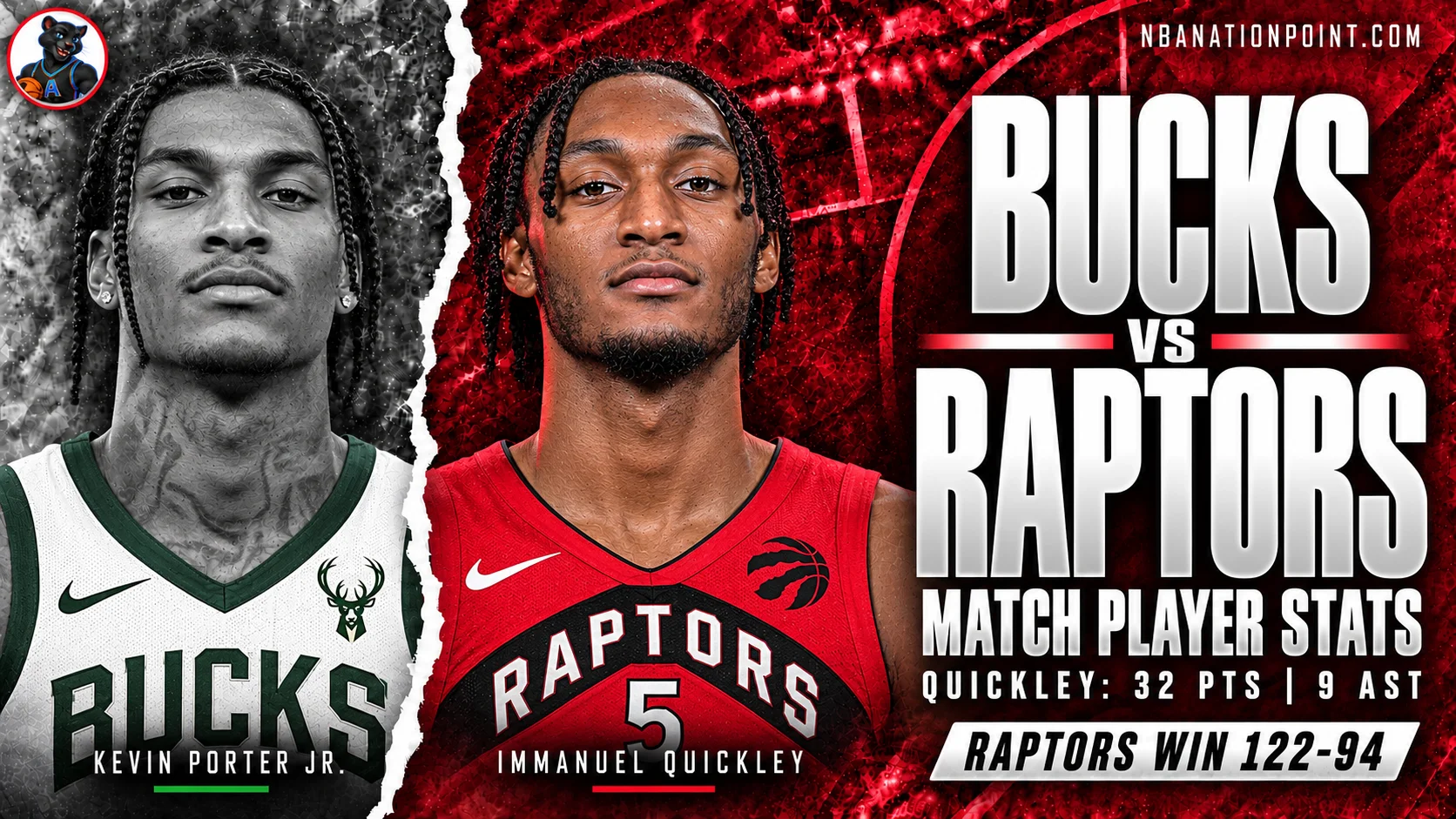
Immanuel Quickley scored 32 points and added nine assists as the Toronto Raptors defeated the Milwaukee Bucks 122–94 at Fiserv Forum on February 22, 2026. Kevin Porter Jr. and Ryan Rollins scored 21 points each for Milwaukee, but Toronto’s shooting, passing and ball security produced a decisive road victory.
For readers searching for Milwaukee Bucks vs Toronto Raptors match player stats, this remains the latest completed regular-season or playoff meeting verified as of November 4, 2026. Their next matchup is scheduled for November 6.
The February contest belonged to Quickley, although Toronto received important contributions throughout its rotation. Brandon Ingram supplied secondary scoring and playmaking, while the Raptors’ reserves helped extend the advantage.
Bucks vs Raptors: Game Summary
| Detail | Result |
|---|---|
| Game date | February 22, 2026 |
| Competition | 2025–26 NBA regular season |
| Venue | Fiserv Forum, Milwaukee |
| Final score | Toronto Raptors 122, Milwaukee Bucks 94 |
| Leading scorer | Immanuel Quickley — 32 points |
| Milwaukee scoring leaders | Kevin Porter Jr. and Ryan Rollins — 21 each |
| Largest lead | Toronto — 31 points |
Milwaukee led after the opening quarter, but Toronto took control across the middle two periods.
| Team | First quarter | Second quarter | Third quarter | Fourth quarter | Final |
|---|---|---|---|---|---|
| Toronto Raptors | 22 | 38 | 32 | 30 | 122 |
| Milwaukee Bucks | 27 | 24 | 22 | 21 | 94 |
Toronto outscored Milwaukee 70–46 across the second and third quarters. That stretch transformed a five-point deficit into a 19-point lead entering the fourth.
Toronto Raptors Player Stats
Quickley delivered the highest scoring total, while Ingram and the bench provided enough support to prevent Milwaukee from concentrating its defense on one player.
| Player | Minutes | Points | Rebounds | Assists | Field goals |
|---|---|---|---|---|---|
| Immanuel Quickley | 30:55 | 32 | 3 | 9 | 11–19 |
| Brandon Ingram | 31:10 | 22 | 2 | 6 | 8–17 |
| Sandro Mamukelashvili | 22:44 | 15 | 4 | 4 | 6–12 |
| Jamal Shead | 22:37 | 12 | 6 | 6 | 4–9 |
| Ja’Kobe Walter | 30:19 | 9 | 6 | 3 | 3–10 |
| Collin Murray-Boyles | 19:39 | 8 | 4 | 0 | 3–4 |
| RJ Barrett | 26:30 | 7 | 6 | 3 | 2–10 |
| Jakob Poeltl | 25:51 | 6 | 8 | 2 | 3–4 |
The Raptors managed a convincing win despite difficult shooting performances from Barrett and Walter. Their combined five makes from 20 attempts did not derail the offense because Toronto found production elsewhere.
Poeltl also contributed without needing many shots. His rebounding gave Toronto another source of possession support, while the guards handled most of the scoring and distribution.
Milwaukee Bucks Player Stats
Porter and Rollins shared Milwaukee’s scoring lead, but their shooting numbers tell different stories.
| Player | Minutes | Points | Rebounds | Assists | Field goals |
|---|---|---|---|---|---|
| Kevin Porter Jr. | 30:52 | 21 | 2 | 10 | 8–11 |
| Ryan Rollins | 33:09 | 21 | 9 | 1 | 6–17 |
| Cam Thomas | 21:12 | 15 | 3 | 1 | 5–9 |
| Myles Turner | 24:49 | 14 | 4 | 1 | 6–11 |
| Bobby Portis | 17:56 | 6 | 7 | 1 | 3–8 |
| Jericho Sims | 24:00 | 4 | 7 | 2 | 2–3 |
| Kyle Kuzma | 18:18 | 3 | 4 | 1 | 1–3 |
| AJ Green | 25:42 | 3 | 1 | 1 | 1–6 |
Porter offered Milwaukee’s strongest combination of efficient scoring and creation. He recorded a double-double, made eight of 11 shots and committed only one turnover.
Rollins added nine rebounds and made four of seven three-pointers. However, he finished two of 10 on attempts inside the arc and committed five turnovers.
Those differences matter when assessing individual performances. Equal scoring totals do not necessarily reflect equal efficiency or the same effect on an offense.
Why Immanuel Quickley Was the Standout Player
Quickley is our player-of-the-game selection because he combined the highest scoring total with efficient shooting and productive passing.
He finished:
- 11 of 19 from the field.
- Five of 11 from three-point range.
- Five of five at the free-throw line.
- Nine assists against one turnover.
His scoring gave Toronto a clear offensive leader, while his distribution helped involve teammates. Milwaukee had to account for both his own shot and the opportunities he could create for others.
Ingram’s contribution was also valuable. His 22 points and six assists gave Toronto another creator, reducing the need for Quickley to organize every possession.
The player-of-the-game choice here is an editorial assessment rather than a claim that an official NBA award was presented.
Turnovers and Three-Pointers Explain the Winning Margin
The clearest differences appeared in possession management and outside shooting.
| Team statistic | Raptors | Bucks |
|---|---|---|
| Field-goal shooting | 46.8% | 41.2% |
| Three-pointers | 16–46 | 9–32 |
| Assists | 34 | 18 |
| Total turnovers, including team turnovers | 8 | 19 |
| Points off turnovers | 27 | 8 |
| Bench points | 46 | 32 |
| Rebounds | 45 | 46 |
| Second-chance points | 21 | 11 |
Toronto made seven more three-pointers, creating a 21-point advantage from beyond the arc.
The Raptors also scored 19 more points off turnovers. These advantages overlap within the final score, so they should not be added together as separate explanations for the margin. Nevertheless, both show where Milwaukee repeatedly lost ground.
Rebounding offers a useful contrast. The Bucks actually collected one more rebound overall. Toronto’s victory therefore cannot be explained simply as domination on the boards.
Instead, the Raptors made more effective use of their opportunities, including a 10-point advantage in second-chance scoring.
How Toronto Stopped Milwaukee’s Comeback
The Bucks reached halftime trailing 60–51 and reduced the deficit to 62–59 during the third quarter.
That was a meaningful opportunity to change the game. Toronto responded with a 10–0 run, restoring a double-digit advantage before Milwaukee could complete the comeback.
The Raptors subsequently entered the fourth quarter ahead 92–73. From that position, Milwaukee needed sustained defensive stops and a much stronger offensive stretch.
Toronto kept enough scoring available to prevent that recovery. Its reserves mattered here: Shead contributed passing and rebounding alongside his 12 points, while Mamukelashvili supplied 15 points and three three-pointers.
Their combined production helped make the victory more than a Quickley scoring showcase.
Who Was Missing From the February Meeting?
Giannis Antetokounmpo missed the game with a right calf strain. Toronto played without Scottie Barnes, who was absent for personal reasons.
Both absences belong to the context of February 22. They should not be treated as current availability updates for the November rematch.
Milwaukee’s defeat ended a three-game winning streak. Toronto also secured a 3–1 victory in the 2025–26 season series, winning the final three meetings.
When Do the Bucks and Raptors Play Again?
The next verified meeting is scheduled for November 6, 2026, at Fiserv Forum, with tipoff listed for 7 p.m. Central, or 8 p.m. Eastern. It is an NBA Cup East Group A game.
That contest belongs to a new season, so February’s lineups and injury circumstances cannot establish the November favorite.
What the previous meeting does provide is a clear tactical reference: Milwaukee must protect possession, limit Toronto’s clean outside opportunities and sustain its offense through changes in the rotation. Toronto’s strongest February combination was efficient guard play supported by several reliable contributors.