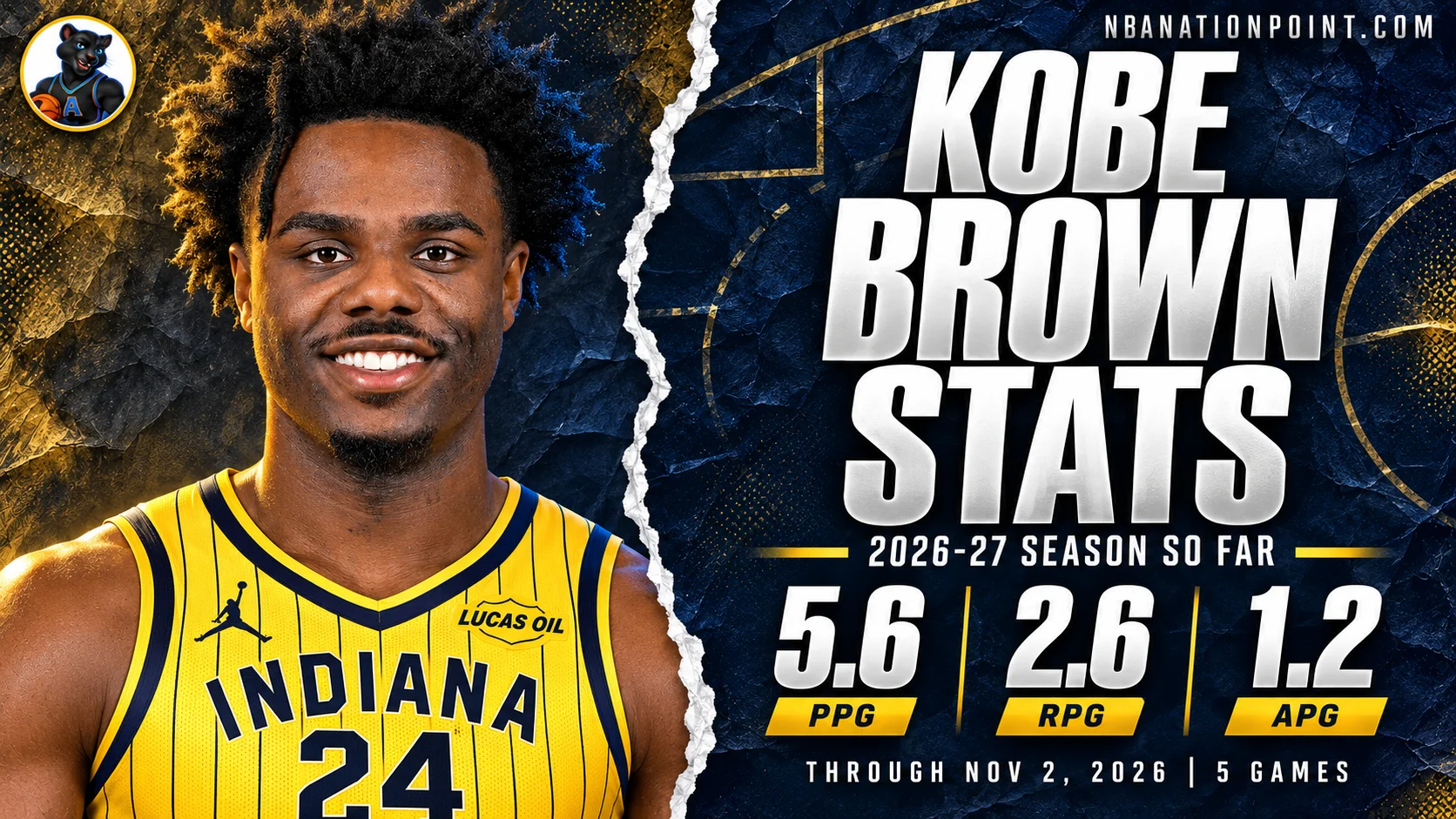
Kobe Brown is averaging 5.6 points, 2.6 rebounds and 1.2 assists in 14.9 minutes per game for the Indiana Pacers in the 2026–27 NBA regular season. Through his first five appearances, he is shooting 47.6% from the field, 30.0% from three-point range and 83.3% at the free-throw line.
His latest performance brought his most productive scoring night of the season so far. Brown finished with 16 points and six rebounds in Indiana’s 108–104 loss to the Atlanta Hawks on November 2.
However, the circumstances behind that performance matter. Indiana used only six players, giving Brown substantially more playing time than his season average.
Statistics below cover NBA regular-season games through November 2, 2026. This article was checked on November 4, 2026. Preseason and G League numbers are excluded.
Kobe Brown Stats for the 2026–27 Season
Brown has appeared in five games without making a start. His averages reflect a mixture of brief appearances and more substantial recent opportunities.
| Statistic | Season figure |
|---|---|
| Team | Indiana Pacers |
| Games played | 5 |
| Games started | 0 |
| Minutes per game | 14.9 |
| Points per game | 5.6 |
| Rebounds per game | 2.6 |
| Assists per game | 1.2 |
| Steals per game | 0.2 |
| Blocks per game | 0.0 |
| Turnovers per game | 0.6 |
| Three-pointers made per game | 0.6 |
The most useful starting point is his playing time. A scoring average of 5.6 points means something different for a player averaging fewer than 15 minutes than it would for someone playing most of each game.
Even that minutes average needs context. Brown’s opportunities have varied considerably, so it does not describe a fixed nightly assignment.
Season Totals and Shooting Percentages
Brown has scored 28 points, collected 13 rebounds and recorded six assists across his five appearances.
| Shooting category | Made–attempted | Percentage |
|---|---|---|
| Field goals | 10–21 | 47.6% |
| Three-pointers | 3–10 | 30.0% |
| Free throws | 5–6 | 83.3% |
These are small shooting samples. Brown has attempted only 10 three-pointers, meaning one additional make would move his percentage from 30% to 40% over the same number of attempts.
His overall field-goal percentage therefore provides an early snapshot rather than a settled measure of his shooting ability this season.
The same caution applies to his free throws. Making five of six is a positive result, but six attempts cannot establish how reliably he will shoot over several months.
Kobe Brown’s Game Log This Season
His five appearances show how strongly the latest game has influenced his averages.
| Date | Opponent | Points | Rebounds | Assists |
|---|---|---|---|---|
| October 23, 2026 | Dallas Mavericks | 0 | 0 | 0 |
| October 26, 2026 | Milwaukee Bucks | 0 | 0 | 0 |
| October 30, 2026 | Miami Heat | 9 | 6 | 4 |
| November 1, 2026 | Brooklyn Nets | 3 | 1 | 1 |
| November 2, 2026 | Atlanta Hawks | 16 | 6 | 1 |
Brown received extremely limited playing time in his first two appearances. Those games still count toward his per-game averages.
Across his three most recent appearances, he has averaged 9.3 points, 4.3 rebounds and 2.0 assists. Those figures are calculated from the game log above.
That recent production is worth following, although three games remain too few to establish a dependable trend. His workload also changed substantially between those outings.
His Best Game So Far: 16 Points Against Atlanta
Brown’s strongest scoring performance came against the Hawks on November 2.
He recorded:
- 16 points
- Six rebounds
- One assist
- One steal
- Six makes from 11 field-goal attempts
- Two makes from six three-point attempts
- Two makes from two free throws
He played approximately 38 minutes, a much larger workload than his season average.
Brown scored 16 of his first 28 season points in that single appearance. That illustrates why his overall numbers can change quickly at this stage of the schedule.
The performance also showed that he could contribute when asked to stay involved for extended stretches. He scored efficiently overall, helped on the boards and committed one turnover despite the increased playing time.
Why Brown Played So Many Minutes
Indiana’s unusually short rotation is essential to understanding the Atlanta game.
The Pacers had only six available players because of injuries, rest and other absences. Brown was their only reserve, while the other five available players started.
That left very little room for normal substitutions. His extended minutes were connected to the roster situation rather than evidence that he had secured a permanent 38-minute role.
For readers assessing Kobe Brown stats, this distinction prevents an unrealistic expectation. His production demonstrated what he delivered in that opportunity; his future workload will depend on Indiana’s available players and rotation decisions.
What His Rebounding and Passing Add
Brown’s recent contributions have extended beyond scoring.
Against Miami on October 30, he finished with nine points, six rebounds and four assists in approximately 20 minutes. That was his highest assist total of the season through November 2.
He then matched the six-rebound total against Atlanta.
These performances suggest that points alone offer an incomplete view of his early contribution. Rebounding and moving the ball can help him remain useful even when he receives relatively few shooting opportunities.
However, the available numbers do not establish that he will consistently provide those totals. His season contains only five appearances, including two with very little court time.
Which Team Does Kobe Brown Play For?
Brown currently plays for the Indiana Pacers, wearing No. 24.
Indiana acquired him from the Los Angeles Clippers in February 2026 as part of the trade that also brought Ivica Zubac to the Pacers. Brown subsequently signed a two-way contract with Indiana in July.
That background explains why older Kobe Brown statistics may appear under the Clippers. His current-season NBA numbers belong to Indiana, while his 2025–26 season includes appearances for both organizations.
What to Watch as His Season Continues
The clearest indicator of Brown’s progress will be whether he receives regular playing time when Indiana has more players available.
His three-point shooting also needs a larger sample. Ten attempts cannot establish whether his early 30% mark will improve or decline.
Finally, his rebounding and passing deserve attention alongside scoring. If he can contribute in those areas while protecting possession, he gives himself additional ways to help the team.
For now, Brown’s season is defined by modest overall averages, uneven opportunities and one productive extended appearance. His Atlanta performance is encouraging evidence of what he delivered when needed, while a longer stretch of games will reveal how much of that production he can sustain.